What is a Transformer?
A Transformer is a special type of Artificial Intelligence model designed to understand language, patterns, meaning, and relationships between words.
Transformers are the technology behind:
- ChatGPT
- Google Gemini
- Claude AI
- GitHub Copilot
- AI Image Generators
Transformers became revolutionary because they can process ALL words in a sentence at the same time.
word → word → word → word
ALL WORDS TOGETHER
This makes Transformers:
- Faster
- Smarter
- Better at long sentences
- Better at reasoning
- Better at conversations
A Transformer works in several stages.
The sentence first becomes tokens.
Tokens become embeddings.
Attention helps words communicate.
Neural networks learn patterns.
Finally, the Transformer predicts the next most likely word.
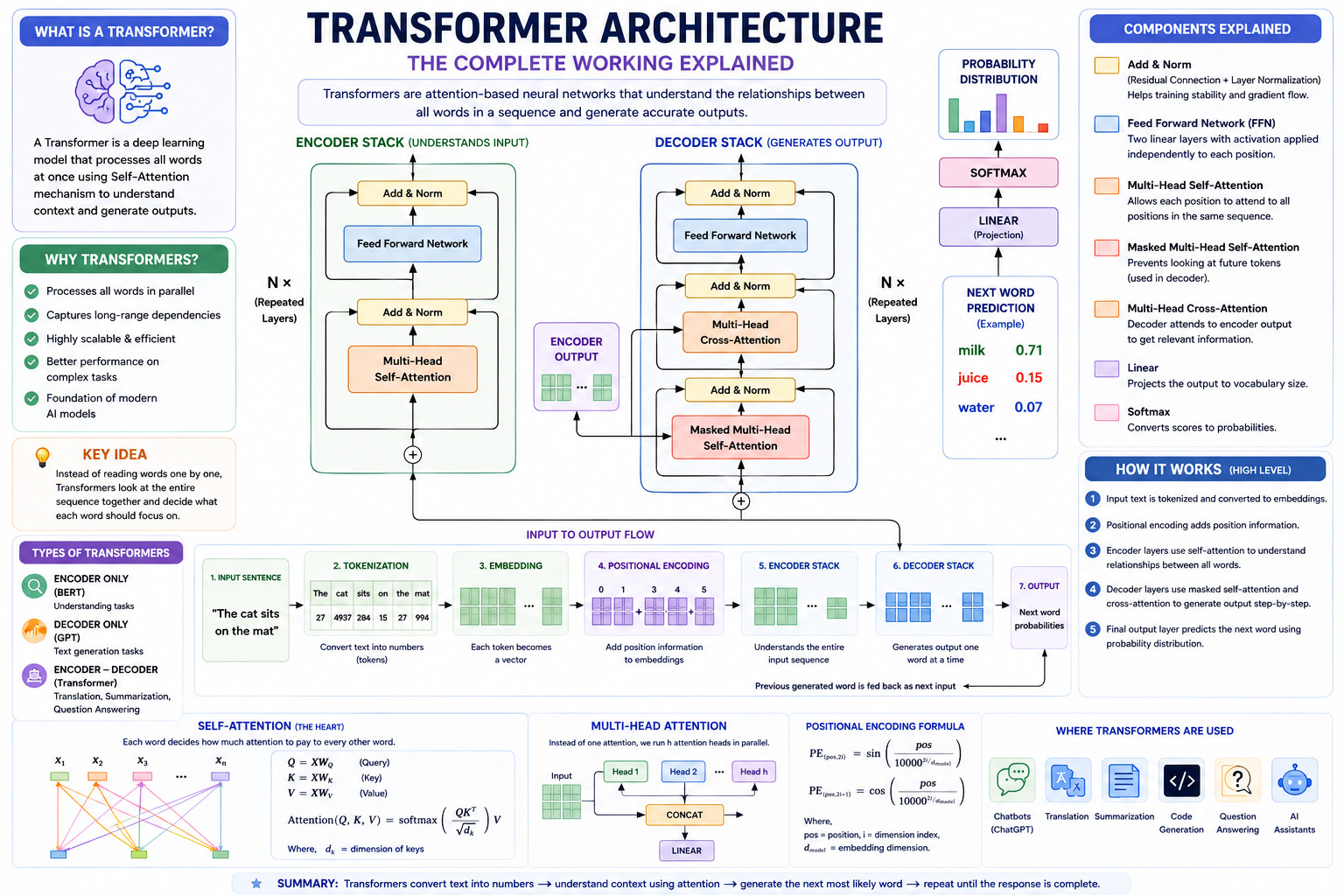
Complete Transformer Architecture
This is the overall architecture of a Transformer model.
Let us understand every major block.
Each layer learns something different.
- Tokens learn word pieces
- Embeddings learn meaning
- Attention learns relationships
- Neural networks learn patterns
- Softmax calculates probabilities
Transformers repeat these layers many times.
GPT models may contain:
- 12 layers
- 32 layers
- 96 layers
- 100+ layers
More layers allow deeper understanding.
Why Transformers Changed AI
Before Transformers, AI models struggled with:
- Long sentences
- Memory problems
- Slow training
- Weak reasoning
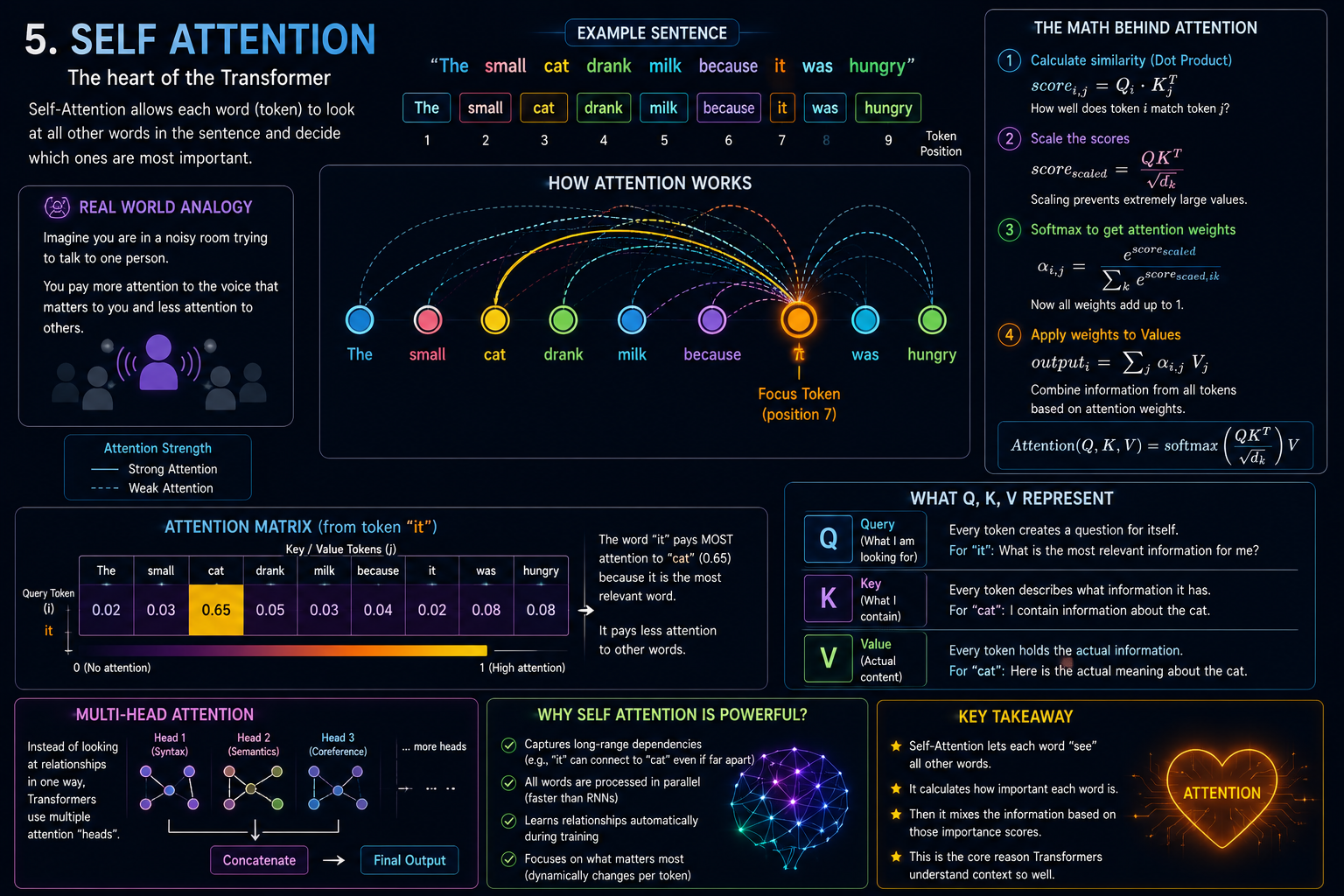
Transformers solved this using Self Attention.
Attention allows every word to look at every other word.
The word:
can connect back to:
This makes language understanding dramatically better.
1. Tokenization
Computers cannot understand words directly.
Transformers only understand numbers.
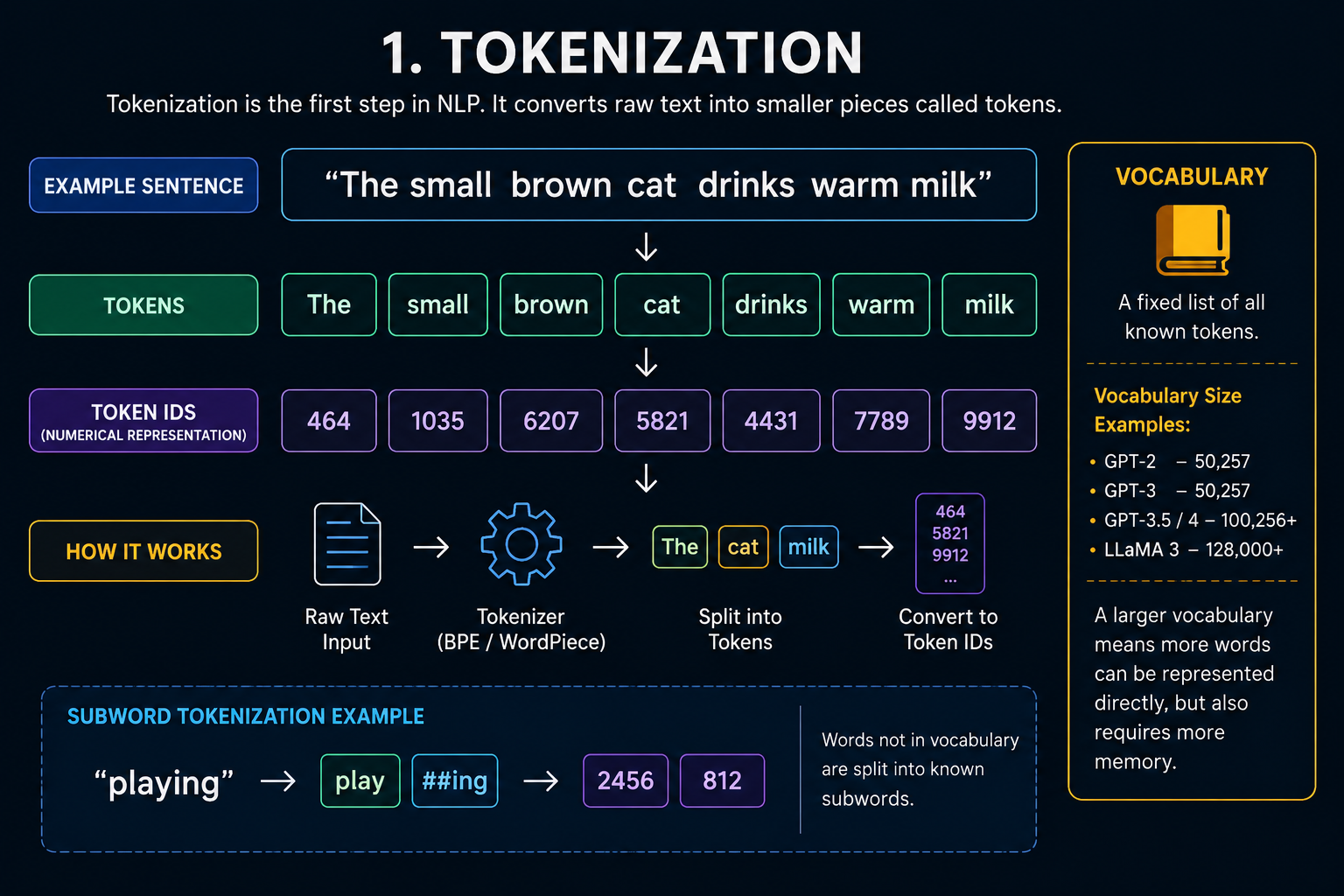
So the first step is converting text into smaller pieces called tokens.
Example sentence:
becomes:
Sometimes words split further:
This helps the AI understand millions of possible words efficiently.
Every token receives a numerical ID.
milk → 9912
warm → 4431
2. Embeddings
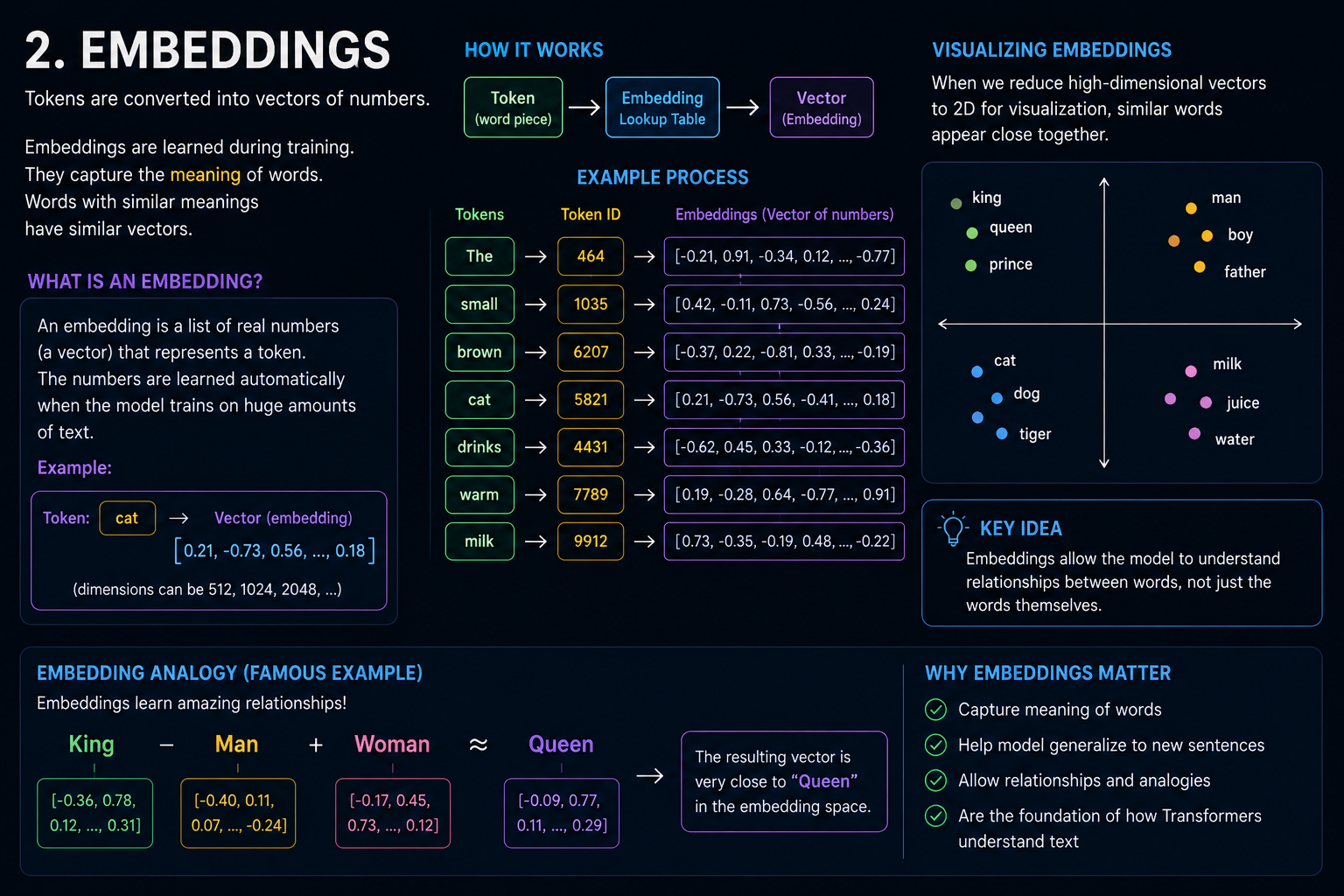
Token IDs alone do not contain meaning.
So Transformers convert tokens into vectors called embeddings.
These numbers are learned during training.
Similar words get similar vectors.
Embeddings allow Transformers to understand meaning mathematically.
3. Positional Encoding
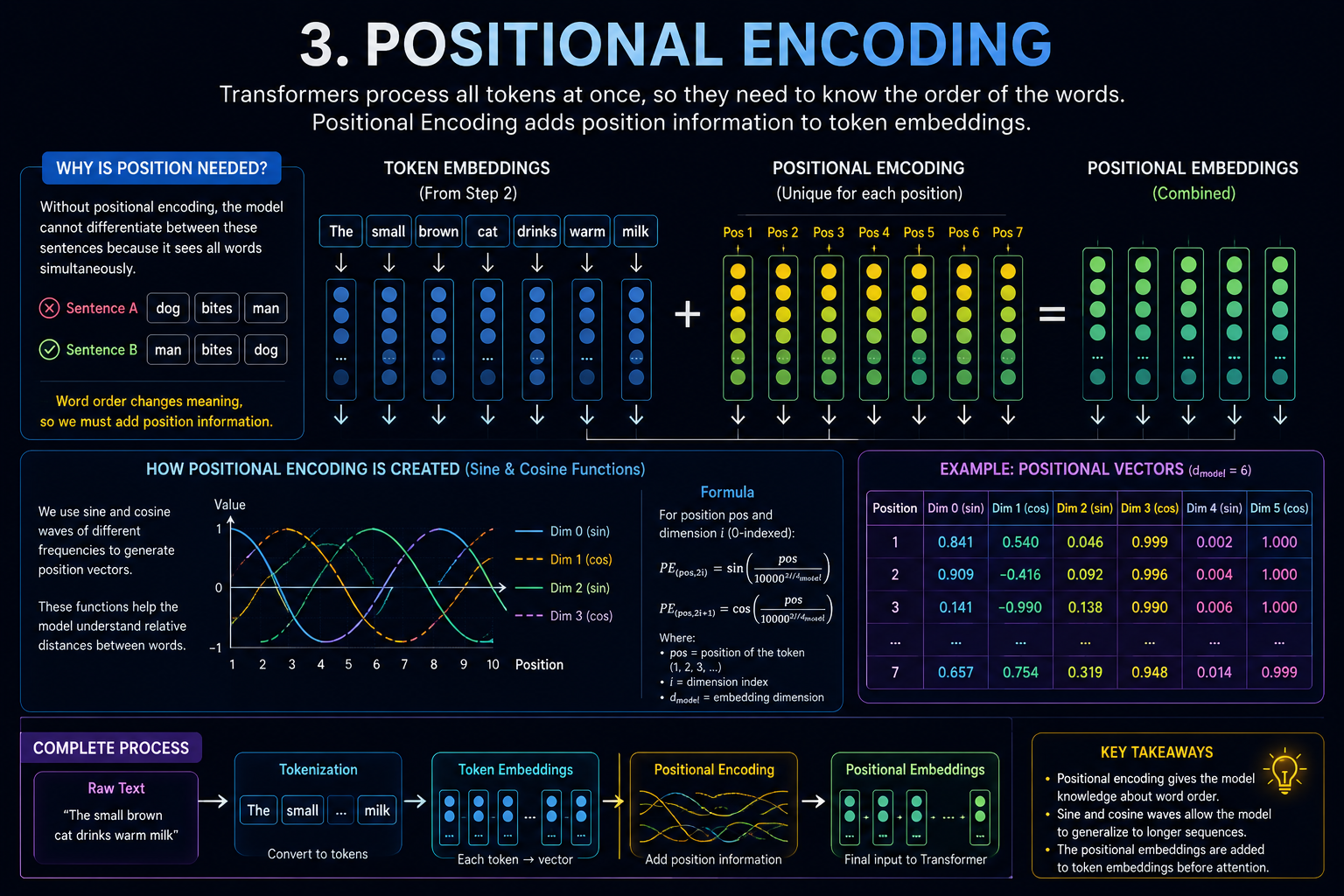
Transformers process all words simultaneously.
So they need position information.
Without positional encoding:
and:
would look similar.
Position vectors solve this problem.
4. Query Key Value
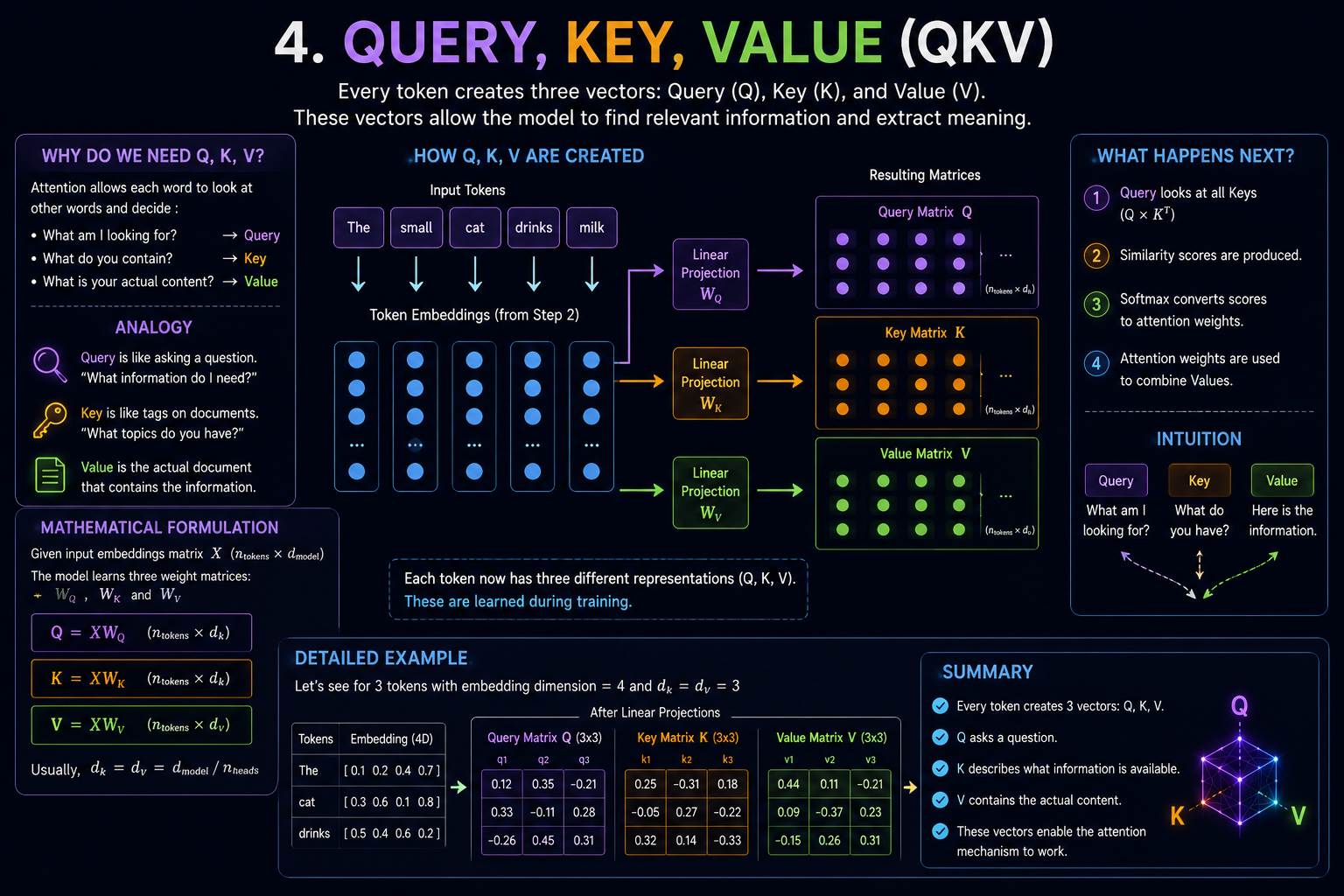
Every token creates 3 vectors:
- Query
- Key
- Value
K = XWk
V = XWv
Query asks:
Keys contain information.
Values contain meaning.
5. Self Attention
Attention is the heart of Transformers.
Words communicate with each other.
The word:
must understand:
Attention calculates relationships mathematically.
6. Attention Matrix
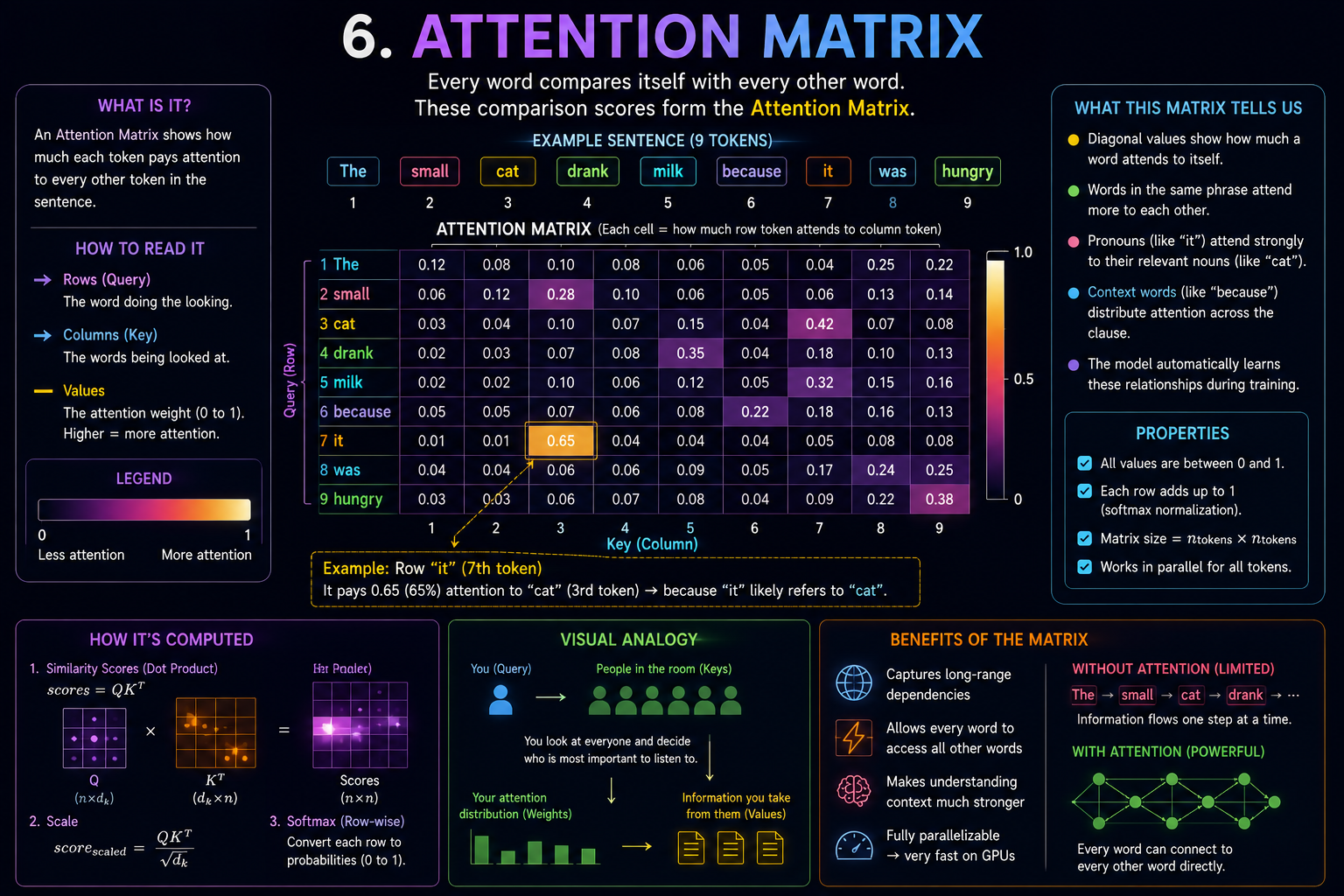
Every word compares itself with every other word.
This creates an Attention Matrix.
0.7 0.1 0.3
0.4 0.9 0.2
Bright cells mean stronger attention.
7. Feed Forward Neural Network
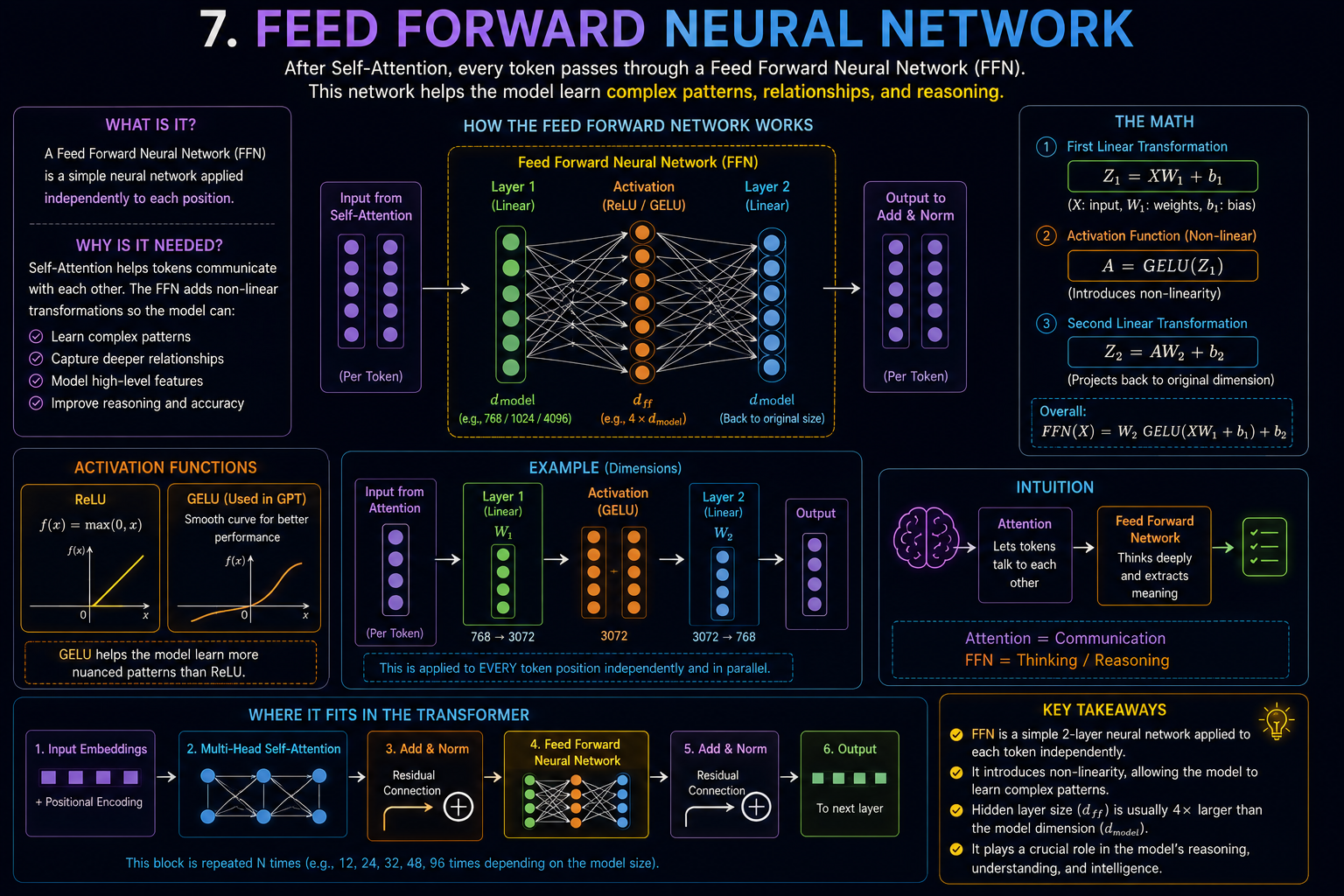
After Attention, tokens pass through neural networks.
This network learns:
- Patterns
- Grammar
- Reasoning
- Concept relationships
This is where intelligence emerges.
8. Softmax
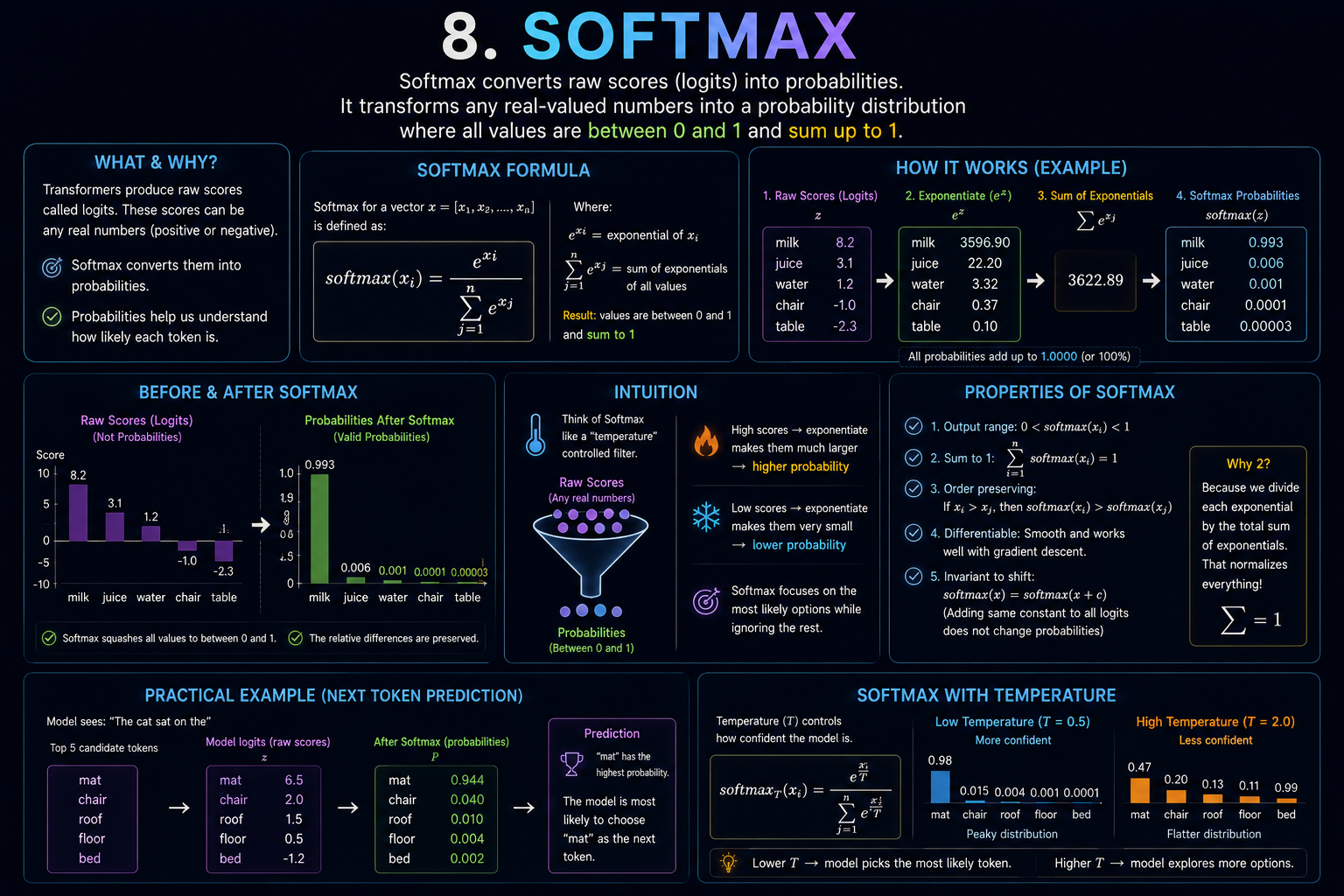
Transformers produce raw scores called logits.
juice → 3.1
chair → 1.2
Softmax converts them into probabilities.
juice → 10%
chair → 2%
9. Training Process
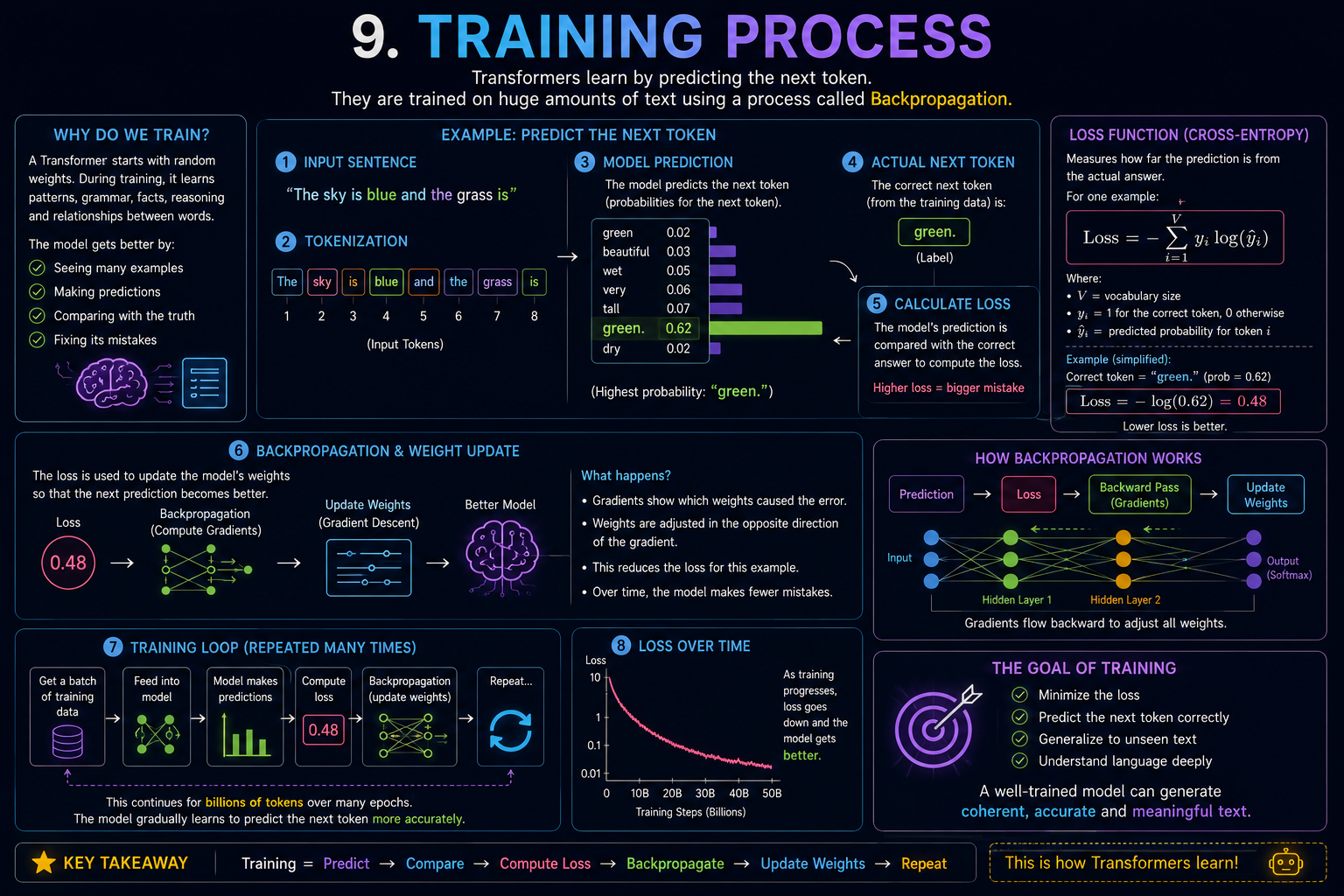
Transformers learn by predicting missing words.
Suppose the AI predicts:
But the correct answer is:
The model calculates error.
Then Backpropagation updates neural network weights.
10. Next Token Prediction
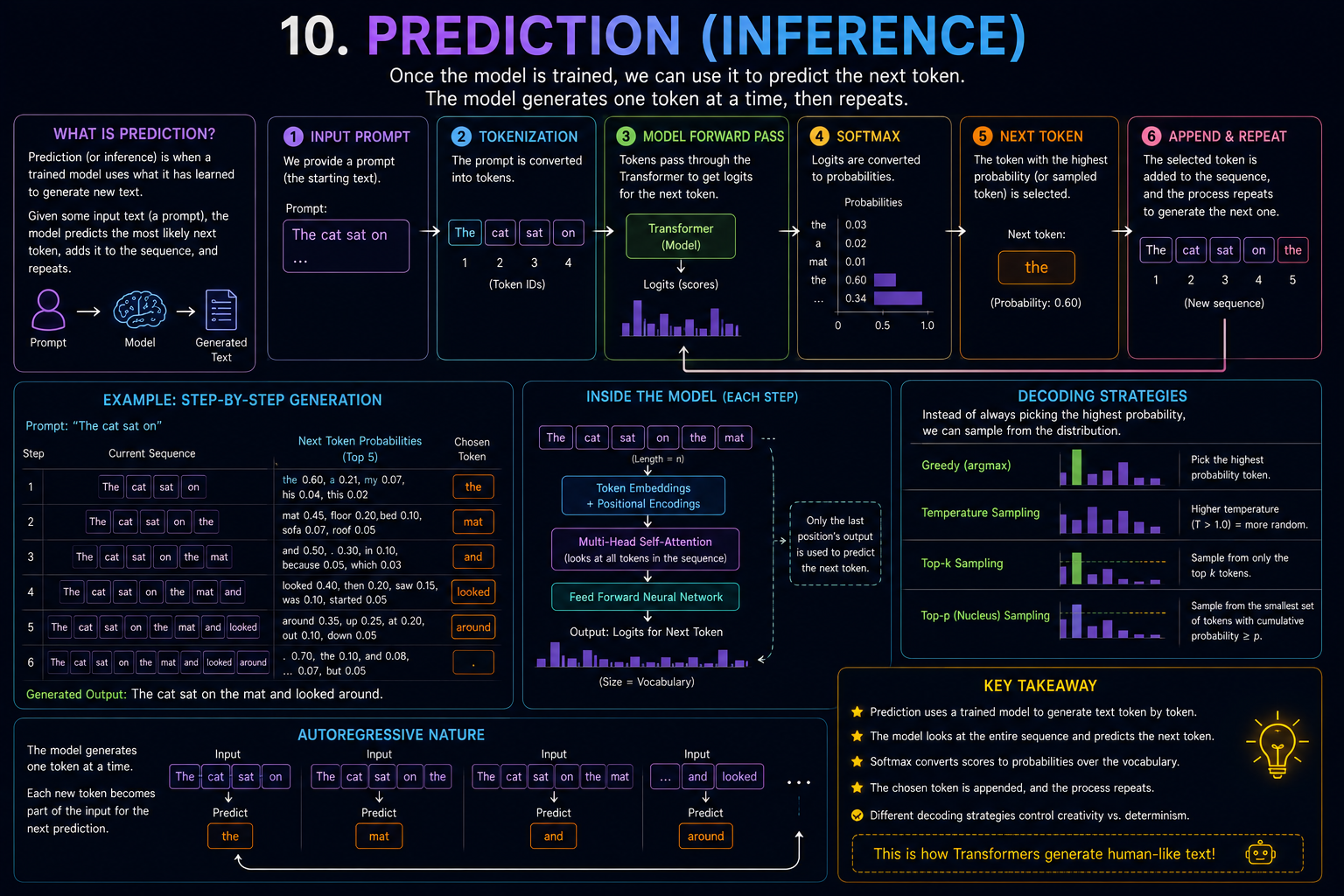
ChatGPT predicts one token at a time.
The Transformer calculates probabilities:
juice → 10%
water → 4%
The highest probability token is selected.
Then the process repeats again for the NEXT token.
11. Why Transformers Were Invented
Before Transformers, AI used older models called RNNs and LSTMs.
These older models processed words one-by-one.
Example:
This was very slow.
Older models also forgot information from earlier parts of long sentences.
Example:
The model might forget who "he" refers to.
Transformers solved this problem using Attention.
Instead of reading words one-by-one, Transformers look at ALL words together.
This made AI:
- Faster
- Smarter
- Better at long context
- Better at reasoning
12. Vocabulary Size
Transformers store a huge dictionary called the Vocabulary.
Every known token gets an ID.
milk → 9912
computer → 22441
Vocabulary size means:
Small AI models may know:
- 10,000 tokens
- 30,000 tokens
Large GPT models may know:
- 50,000+
- 100,000+
More vocabulary means better language understanding.
It also helps the AI understand:
- code
- math
- multiple languages
- scientific words
13. Parameters and Weights
Transformers contain billions of learned numbers called parameters.
Parameters are like tiny pieces of learned knowledge.
During training, these numbers continuously change.
Example:
After billions of corrections, the model slowly learns language.
Large GPT models may contain:
- 7 billion parameters
- 70 billion parameters
- 1 trillion+ parameters
More parameters allow the model to learn more complex patterns.
14. GPUs and AI Training
Training Transformers requires enormous computing power.
GPUs are special processors designed for parallel math operations.
Transformers perform huge amounts of matrix multiplication.
GPUs can calculate thousands of operations simultaneously.
Modern AI training may use:
- thousands of GPUs
- millions of training examples
- weeks or months of computation
This is why advanced AI systems are extremely expensive to train.
15. Context Window
Transformers cannot remember forever.
They only see a limited number of tokens at once.
This is called the Context Window.
Example:
Bigger context windows allow:
- long conversations
- large code files
- entire books
- huge documents
Modern AI models may support:
- 8K tokens
- 32K tokens
- 128K tokens
- 1 million+ tokens
16. Multi Head Attention
Transformers use multiple attention heads simultaneously.
Different heads learn different things.
One head may learn grammar.
Another head may learn meaning.
Another head may learn relationships between distant words.
Example:
Head 2 → pronouns
Head 3 → emotions
This allows Transformers to understand language deeply.
17. Why ChatGPT Feels Intelligent
ChatGPT does NOT think like humans.
Instead, it predicts likely next tokens.
Example:
The Transformer calculates probabilities:
coffee → 30%
lava → 0.0001%
The highest probability token wins.
This happens thousands of times while generating a response.
Intelligence emerges from:
- massive data
- billions of parameters
- attention mechanisms
- pattern learning
18. Hallucinations
Sometimes AI generates incorrect information confidently.
This is called Hallucination.
Hallucinations happen because Transformers predict patterns, not truth.
Example:
Hallucinations occur because:
- training data may be incomplete
- prediction is probabilistic
- AI does not truly "know"
This is why human verification is still important.
Inside the Brain of ChatGPT
Transformers changed AI forever.
Through:
- Attention
- Neural Networks
- Embeddings
- Probability
- Massive Data
- GPU Training
AI systems can now generate human-like language.
Every ChatGPT response is created token-by-token using mathematics.
Modern AI is essentially: