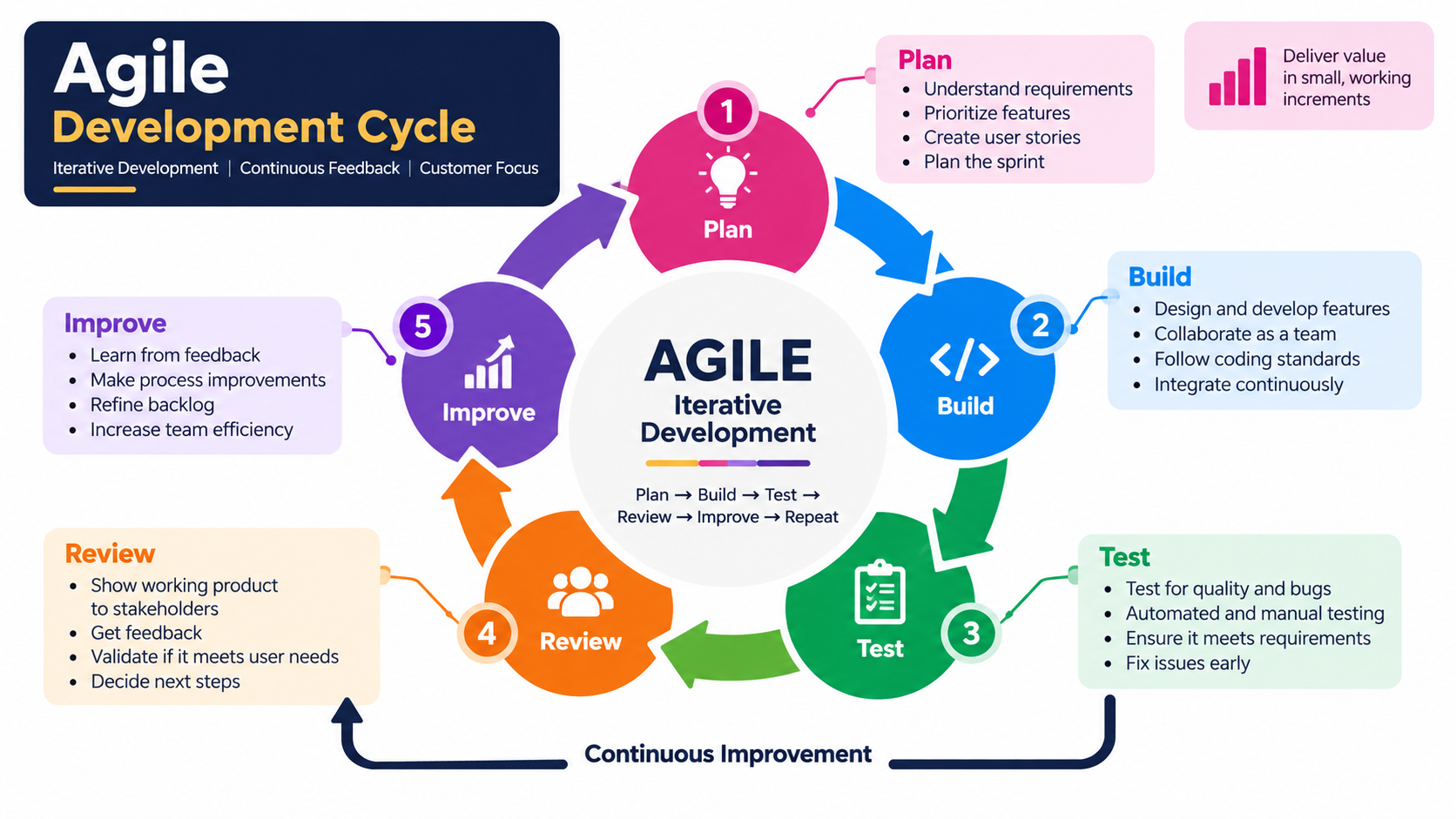
IMAGE 1 · AGILE
Agile: repeat and improve
Work in small cycles, get feedback early, and adjust the next iteration. This is useful when product needs evolve.
File:
images/agile-cycle.svgA practical, beginner-friendly guide to how software teams plan, build, test, release and improve products—with everyday analogies, real-world examples, team roles, tools and hands-on activities.

SDLC stands for Software Development Life Cycle. It is a structured way to turn a problem or idea into software that people can use, maintain and improve.
Imagine opening a small café. You do not immediately buy random furniture and start cooking. You first decide what customers need, plan the menu and budget, design the space, prepare the kitchen, test recipes, open the café, and improve based on customer feedback.
Software development works in a similar way. SDLC gives the team a repeatable process so important steps are not forgotten. The exact stages and names can differ between organizations and methodologies.
Requirements are the family’s needs; design is the blueprint; development is construction; testing is inspection; deployment is handing over the keys; maintenance is fixing leaks and making upgrades.

SDLC is the overall lifecycle. Agile, Waterfall and other approaches describe ways a team can organize work across that lifecycle.
Select a stage to reveal what happens, who helps, and a simple example.
Talk to users, define the problem, identify constraints, estimate effort and agree on what success means.
For a college attendance app, ask who marks attendance, how students view it, and what reports are needed.
Requirements, scope, feasibility notes, risks and a prioritized list of features.
| Stage | Key question | Possible deliverable |
|---|---|---|
| Planning & analysis | Why and for whom? | Requirements / backlog |
| Design | How will it be structured? | Wireframes, architecture, data model |
| Development | Can we build it? | Source code and reviewed changes |
| Testing | Does it meet expectations? | Test cases, defect reports |
| Deployment | Can users access it safely? | Release, configuration, rollback plan |
| Maintenance | How do we keep it useful? | Bug fixes, monitoring, improvements |
Agile is a set of values and principles that encourages teams to deliver useful software in small increments, collaborate closely, learn from feedback and adapt when needs change.
Suppose a group is ordering pizza for an event. Instead of spending weeks planning every topping before anyone tastes anything, the team makes a small batch, gets feedback, and adjusts the next batch. That is the spirit of iterative delivery.
Agile does not mean “no planning” or “no documentation.” It means planning continuously, documenting what is useful, and responding to evidence rather than blindly following an outdated plan.
An iteration is a repeatable work cycle. An increment is a usable addition to the product. Teams often produce an increment in each iteration.

over processes and tools
Tools help, but conversation and collaboration solve misunderstandings.over comprehensive documentation
Useful software is the main evidence of progress; essential documentation still matters.over contract negotiation
Work with users throughout development, not only at the beginning and end.over following a plan
Plans are valuable, but new evidence can justify a change in direction.The wording means the items on the left are valued more, while the items on the right still have value.
Release a basic but useful feature, then expand it.
If users reveal a better need, evaluate and reprioritize it.
Developers, testers, designers and product people stay aligned.
Reflect on what worked and change one thing at a time.
Agile is not a single tool, not simply daily meetings, and not an excuse to skip testing. It is a way of working guided by values and principles.
Scrum is a popular framework used by many Agile teams. It gives a team a lightweight structure for creating, inspecting and adapting a product through short, fixed-length Sprints—often one to four weeks.

Ordered list of product work, improvements and fixes. The Product Owner is accountable for effective backlog management.
The Scrum Team agrees why the Sprint matters, what can be done and how the work may be completed.
Developers inspect progress toward the Sprint Goal and adapt their plan. It is not meant to be a manager’s status interrogation.
Show usable work, inspect results with stakeholders and discuss what to do next.
Inspect how the team worked and choose improvements for the next Sprint.
Trainer login, create a class, mark attendance and save records.
Feedback:“I need to correct a mistaken entry.”
Add authorized edits, date filters and a basic attendance report.
Feedback:“Students want to see their own attendance.”
Add secure student login, percentage display and export options.
Outcome:Release useful features while learning from real users.
| Concept | What it means | When it may fit | Watch out for |
|---|---|---|---|
| SDLC | The overall lifecycle of software work | All software projects need lifecycle thinking | It is not one specific methodology |
| Waterfall | A more sequential approach with phases planned upfront | Stable requirements, formal stage gates, some regulated contexts | Late feedback can make changes expensive |
| Agile | Iterative, incremental work with frequent feedback | Changing needs and opportunities to validate with users | Requires active collaboration and disciplined prioritization |
| Scrum | A framework with accountabilities, events and artifacts | Teams delivering product work in Sprints | Events alone do not make a team Agile |
| Kanban | Visualize workflow, limit work in progress and improve flow | Support, operations and continuous-flow work | A board without flow policies gives limited insight |
These three diagrams are included in your project folder as editable SVG images. You can replace them with your own generated illustrations using the same filenames.
Work in small cycles, get feedback early, and adjust the next iteration. This is useful when product needs evolve.
images/agile-cycle.svg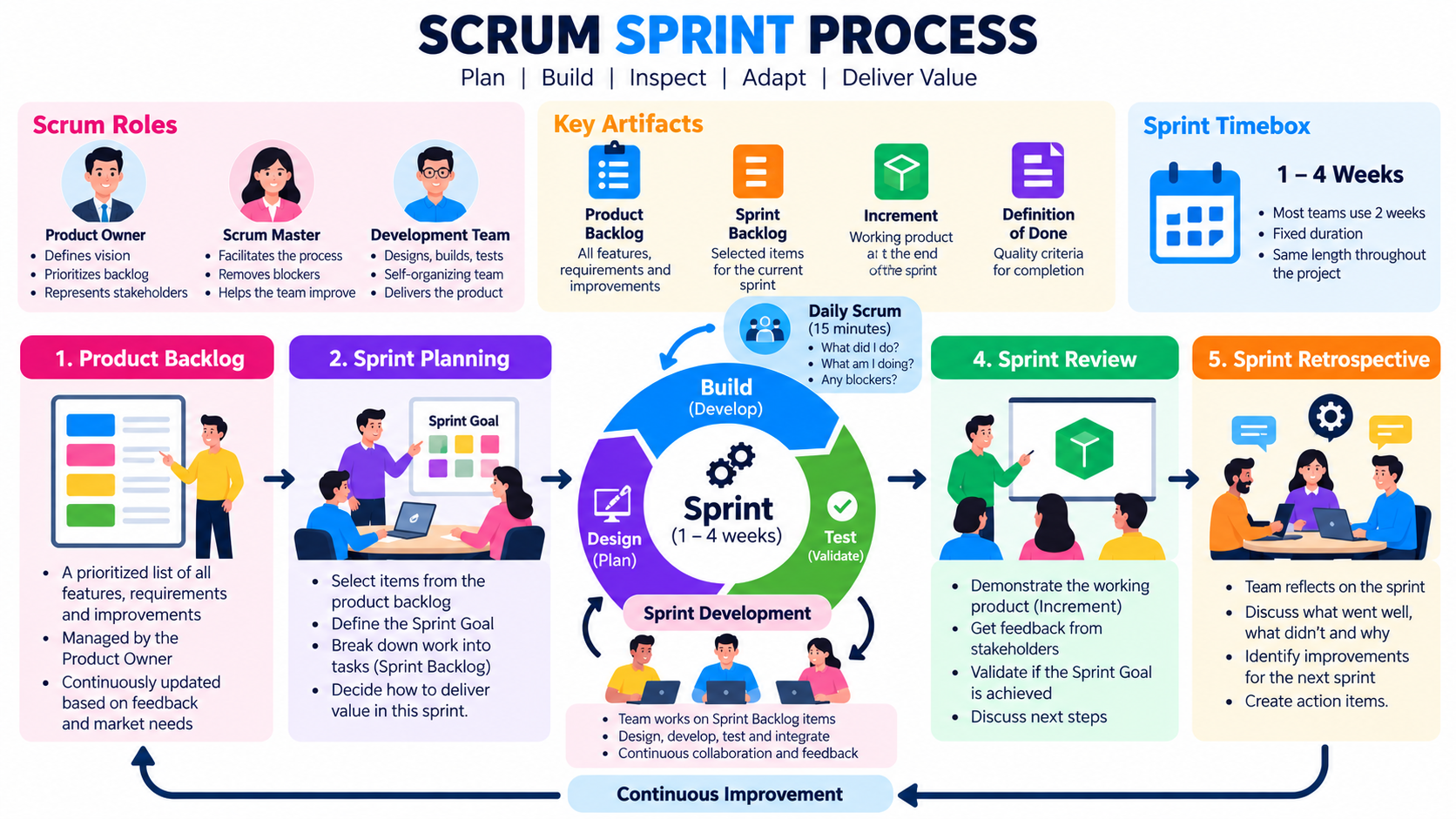
Scrum gives Agile teams a defined framework of accountabilities, events and artifacts. A Sprint creates an increment of value.
images/scrum-sprint.svg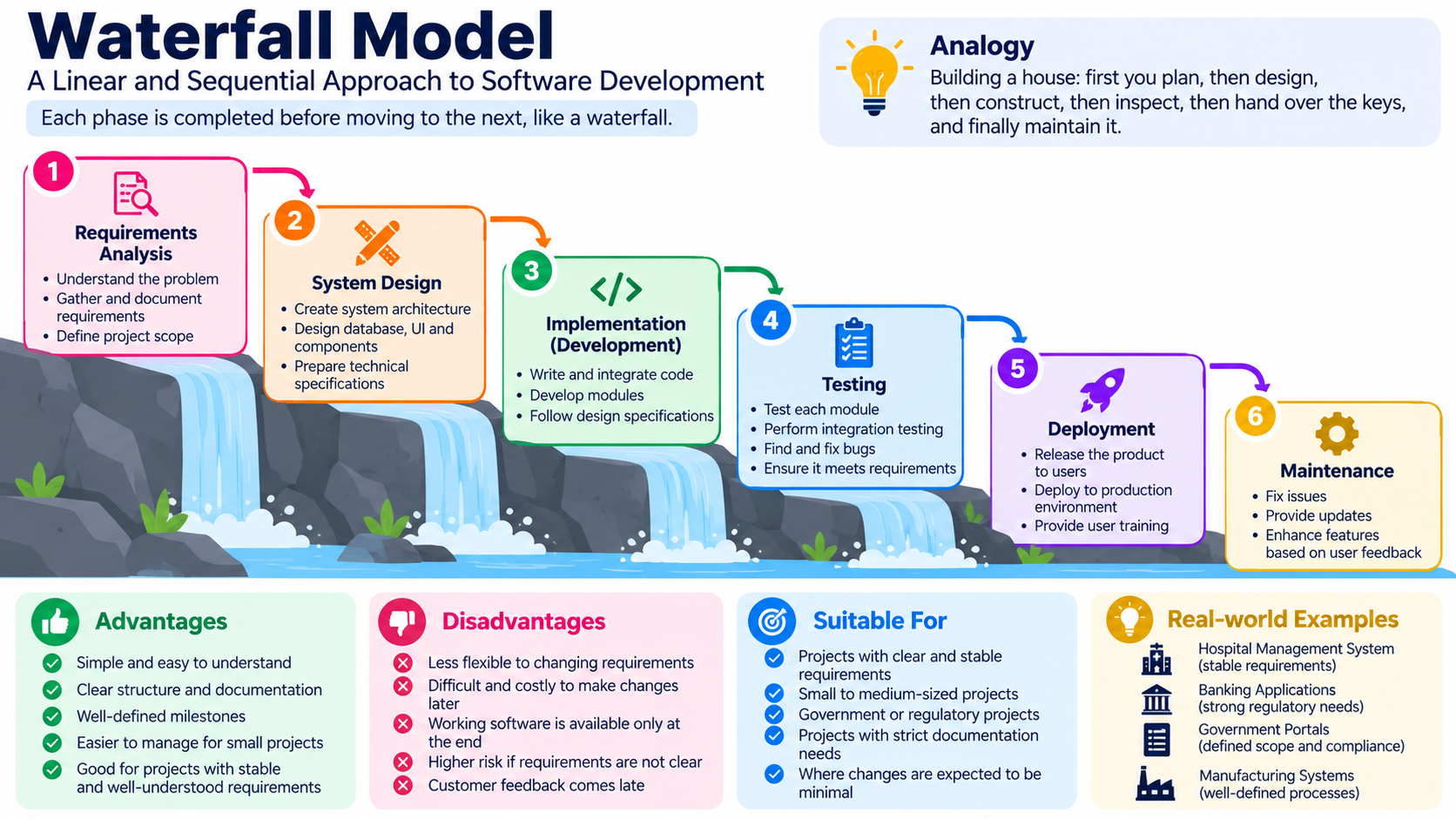
Work progresses through planned stages. It can fit stable requirements and formal approvals, but late changes may be costly.
images/waterfall-model.svgAfter extracting the ZIP, open the images folder. The three SVG files above are already connected to the website. To use images you generate, save them in this folder with the same filenames and update each src in index.html if you use a different filename or format.
For example, save a generated PNG as agile-cycle.png, then change src="images/agile-cycle.svg" to src="images/agile-cycle.png".
Software is a team outcome. In small companies one person may cover several responsibilities; in larger teams these roles may be separate.
Understand user needs, define outcomes, prioritize features and help the team focus on value.
Help the team understand Scrum, remove or escalate impediments, coach collaboration and support continuous improvement.
Design, implement, review, debug and maintain software. Work with APIs, databases, user interfaces and automated tests.
Prevent defects by planning tests, checking requirements, automating repeatable checks and reporting clear reproduction steps.
Research user needs, map journeys, create wireframes and prototypes, and test whether the experience is clear and accessible.
Automate builds and deployments, manage infrastructure, observability, reliability and secure delivery pipelines.
In Scrum, the Product Owner, Scrum Master and Developers are accountabilities within one Scrum Team. QA, design and DevOps are skills or job titles that may exist within or alongside the Developers group.
A tool supports a practice; it does not replace the practice. Teams choose tools based on security, team size, budget, workflow and existing systems.
Illustrative toolchain only. Teams may use different products or combine multiple capabilities in one platform.
Use these activities in pairs or small groups. Each one turns a concept into something learners can explain, sketch or present.
Goal: Experience iterative improvement and user feedback.
Place these tasks under the most appropriate primary stage: interview students, draw a database schema, write a login API, test invalid passwords, publish a release, monitor error logs.
Suggested order: Planning & analysis → Design → Development → Testing → Deployment → Maintenance. Real teams often revisit earlier stages; this is not always a one-way path.
Write three user stories for a library app using this pattern:
Example: “As a student, I want to search by book title, so that I can find a book without browsing every shelf.” Add acceptance criteria that can be checked objectively.
Choose a Sprint Goal such as “Let a student view their attendance.” Each learner briefly shares progress toward the goal, the next step and any blocker. Then the team updates its plan.
A login form accepts a blank password and displays “Welcome!” Create a bug report containing: title, environment, steps to reproduce, expected result, actual result, severity and evidence. Suggest a test case to prevent recurrence.
Choose one answer for each question, then submit. You will get a score and explanations so you can learn from mistakes.
Choose a small problem, talk to a user, sketch the first version, test it, and improve it. Great software is built through learning—not guesswork.